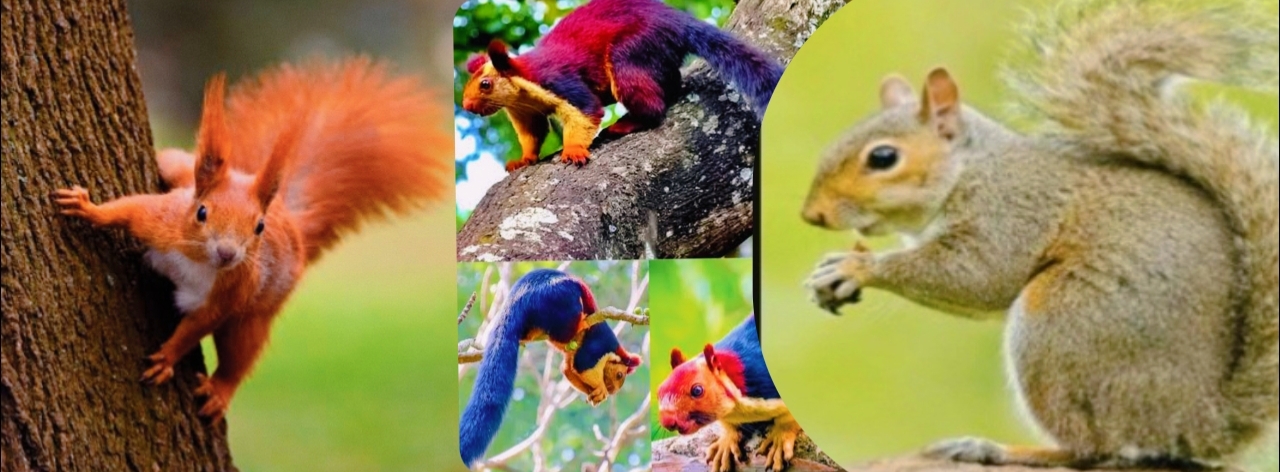
Do all squirrels share the same charm, or are some more different—and more dangerous—than they seem?
Squirrels may look equally cute at first glance, but species like red, grey, and rainbow squirrels vary widely in origin, behavior, and ecological roles.
Each type has unique traits that influence how it survives and interacts with its surroundings.
From the bold and territorial red squirrel to the highly adaptable grey squirrel, and the visually striking rainbow squirrel, these animals showcase surprising diversity.
Their differences go beyond appearance, affecting their habits, competition with other species, and impact on local environments.
Grey Squirrel
The Eastern gray squirrel (Sciurus carolinensis) originates from North America and was introduced to Britain and parts of Europe in the late 1800s.
It is an opportunistic feeder, eating nuts, seeds, fruits, fungi, bark, and even small birds or eggs when available.
This flexible diet gives it a strong survival advantage in different environments.

Native to the United States and Canada, it has now spread widely across the UK, Ireland, and parts of Italy.
Grey squirrels are larger, more adaptable, and more competitive, often dominating in shared habitats.
Ecologically, they are considered the most harmful, as they spread squirrelpox (deadly to red squirrels), outcompete them, and damage trees by stripping bark.
Rainbow Squirrel
The Malabar giant squirrel (Ratufa indica), also known as the “rainbow squirrel,” is native to India.
Also Read | From Rescue To Remembrance: A Chain Of Kindness Cast In Stone
Unlike smaller red and grey squirrels, it is a large tree-dwelling species known for its striking appearance.
Its fur features vibrant shades of maroon, rust, purple, cream, and orange.

It mainly feeds on fruits, nuts, flowers, and bark, with occasional insects, making it largely herbivorous.
This species inhabits tropical forests, especially in the Western Ghats, central India, and parts of Maharashtra.
It can grow up to three feet long, including its tail, and is highly agile, leaping up to 20 feet between treetops.
Red Squirrel
The Red squirrel is a small tree-dwelling mammal found across Europe and northern Asia, known for its reddish-brown coat and distinctive tufted ears.
It is especially iconic in regions like the UK and Scandinavia, where it symbolizes native woodland ecosystems.

Red squirrels mainly feed on conifer seeds, hazelnuts, berries, and fungi, and occasionally consume bird eggs when available.
They are skilled at caching food, storing supplies in advance to survive harsh winter conditions.
Today, their populations are largely confined to Scotland, Ireland, Scandinavia, and Russia, with a notable decline in the UK.
They are well adapted to coniferous forests but remain vulnerable to habitat loss and disease, which continue to threaten their survival.
Common Traits
Despite their differences, all three species belong to the Sciuridae and share key traits.
They have strong hind legs that support agile jumping and climbing.
Their bushy tails help with balance and also serve as communication tools.
All three practice food caching, storing supplies for future use.
They also play an important ecological role by dispersing seeds, aiding forest regeneration.
Squirrels are not a threat to humans and generally avoid close contact, as they are shy, tree-dwelling animals.
However, like most wild creatures, they may bite if they feel cornered or threatened.
Overall, they are harmless in normal situations—so is there really any reason to fear them?


Leave a Reply