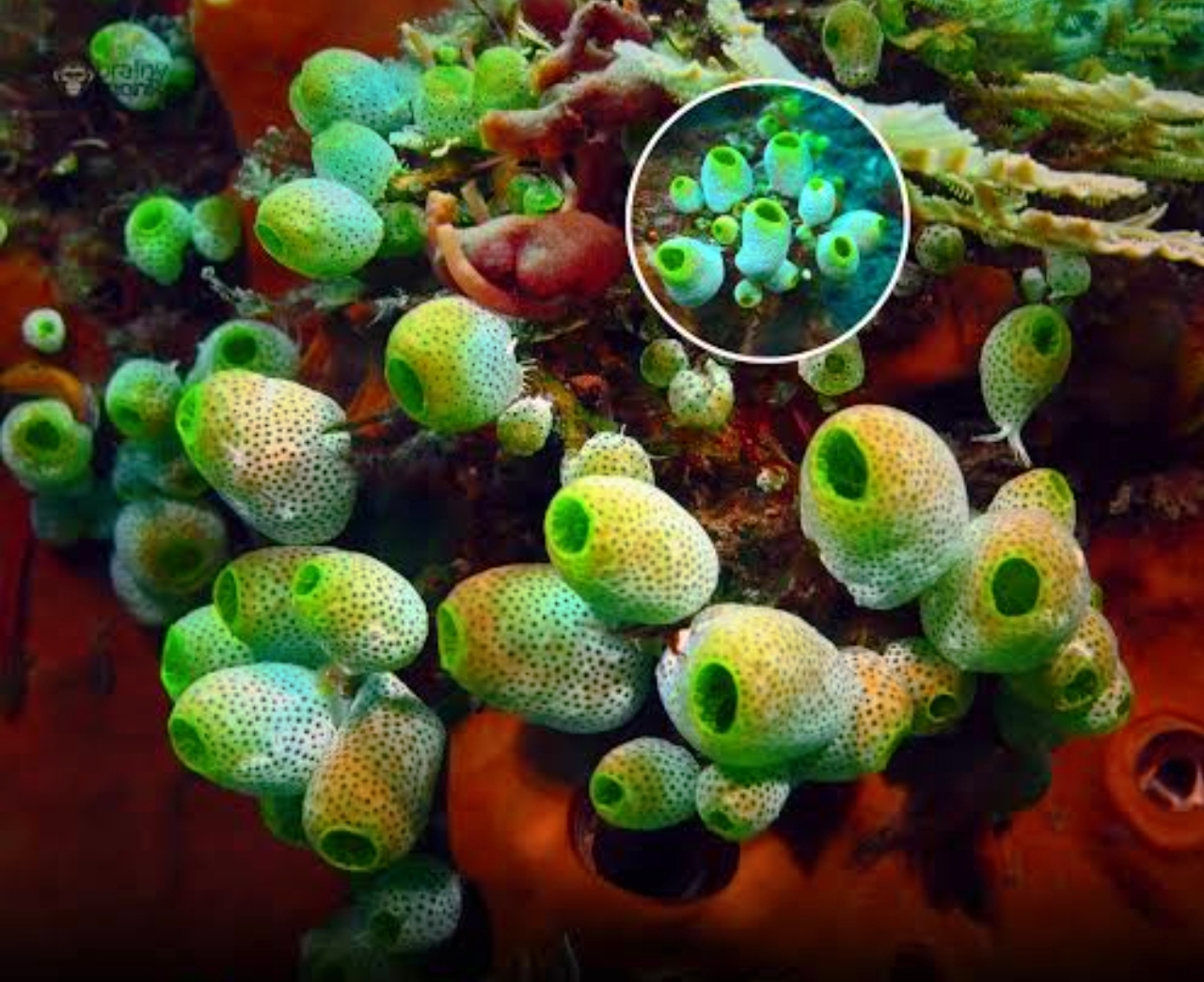
How can an animal be intelligent at birth, yet brainless as an adult? What if your brain were only needed for the first chapter of your life?
Losing your brain might seem like the end of the world, but for a little marine creature, it’s just part of growing up.
The sea squirt is a small, sac-like marine animal with a surprisingly unusual life cycle.
Belonging to the genus Ciona, it starts life as a free-swimming larva with basic sensory structures that guide it through the ocean.
As it matures, it attaches itself to a hard surface like a rock and undergoes a dramatic transformation. Its body reshapes into a soft, blob-like form, typical of tunicates, built for a stationary life.
In one of the strangest twists in the animal kingdom, it no longer needs its early neural features after settling down.
The sea squirt essentially discards much of what it once relied on, embracing a far simpler existence as an adult.
Sea Vase Basics
One well-known species, Ciona intestinalis—often called the sea vase—is a solitary, transparent, filter-feeding organism found in temperate coastal waters.
In its early stage, it looks more like a tiny tadpole than a typical sea creature. Measuring just 1–2 mm in length, the larva has a streamlined body built for movement rather than attachment.
This larval form is surprisingly sophisticated. It includes a primitive brain (the cerebral vesicle), a dorsal nerve cord, a notochord, and a muscular tail that allows it to swim through the water.
The swimming phase is brief—just 1 to 3 days—during which the larva searches for a place to settle.
Its movement is purposeful, not random, directed by environmental signals.
Through phototaxis (light response) and rheotaxis (water flow response), it steers toward suitable surfaces.
Despite its simplicity, its ~200-neuron brain efficiently processes sensory input before it transforms into a stationary adult.
Radical Self-Rewiring
Upon settling headfirst, the larva anchors itself using sticky papillae.
This triggers metamorphosis, a rapid and irreversible transformation.
Autophagy begins, breaking down about 80% of its central nervous system.
Within hours, most of the brain, tail, and notochord are digested as it shifts into its adult form.
From Drifter To Filter Feeder
As it matures, it transforms into a stationary adult, fixed in one place.
It feeds by continuously drawing in surrounding water.
Using tiny openings called gill slits, it filters out plankton and nutrients.
Remarkably, it can process over 100 times its body volume in water each day.
Survival Over Brain Power
Once settled, it becomes stationary and stops moving or foraging for food. A complex brain is no longer necessary for survival at this stage.
Since brains are energy-costly, maintaining them is inefficient, so the organism shifts focus away from neural complexity.
Energy is redirected toward survival and reproduction instead. It prioritizes producing hundreds of eggs in a single reproductive cycle.
This trade-off improves reproductive output over mobility, where efficiency replaces the need for advanced cognition.
At the genetic level, brain-development genes become less active while enzymes increase to break down and recycle unused brain tissue.
The body actively dismantles what it no longer needs, ensuring resources are reused within the organism.
Despite this reduction, a simple nervous system remains intact to handle basic environmental responses, such as reflexes like closing when touched.
One-Time Neural Reset
It is not about replacing the brain, but a single, major rewiring event. The change is sudden and irreversible once it begins. Rather than gradual loss, it is a complete internal reset. This marks a sharp shift in biological function.
The sea squirt forms a basic brain during its free-swimming larval stage. This brain supports navigation and environmental sensing. Once it settles, the brain is fully absorbed. What remains is a simplified adult body plan.
In doing so, it discards traits shared with more advanced chordates. These shared features trace back to a common ancestor. That split occurred roughly 550 million years ago. The transformation reflects deep evolutionary divergence.
Flexible Biology, Minimal Design
This life cycle challenges the idea that brains are always retained. Closely related species do not necessarily preserve the same complexity. Instead, structures may be temporary and stage-dependent. Biology adapts based on life phase, not lineage alone.
It suggests that intelligence is not a fixed requirement. Its value depends entirely on environmental need. What is essential in one stage becomes unnecessary in another. Efficiency can override complexity in evolution.
Researchers found the process is not strictly time-driven. If settlement is prevented, brain absorption is delayed. This shows it is triggered by conditions, not a fixed timer. The system remains responsive and adaptable.
In nature, survival is not about preserving complexity. It is about retaining only what is useful at the moment. Unneeded systems can be removed without penalty. The sea squirt embodies this principle of minimal necessity.
The sea squirt’s life cycle demonstrates that biology is built for efficiency, not permanence. It forms a brain only when needed and later dismantles it when it becomes unnecessary. This extreme transformation highlights how evolution prioritizes function over complexity, constantly reshaping life based on circumstances rather than a fixed design.
If a brain can be built, used, and then discarded, what truly defines “intelligence” in nature?
DISCLAIMER: This article is derived from information available in the public domain.


Leave a Reply