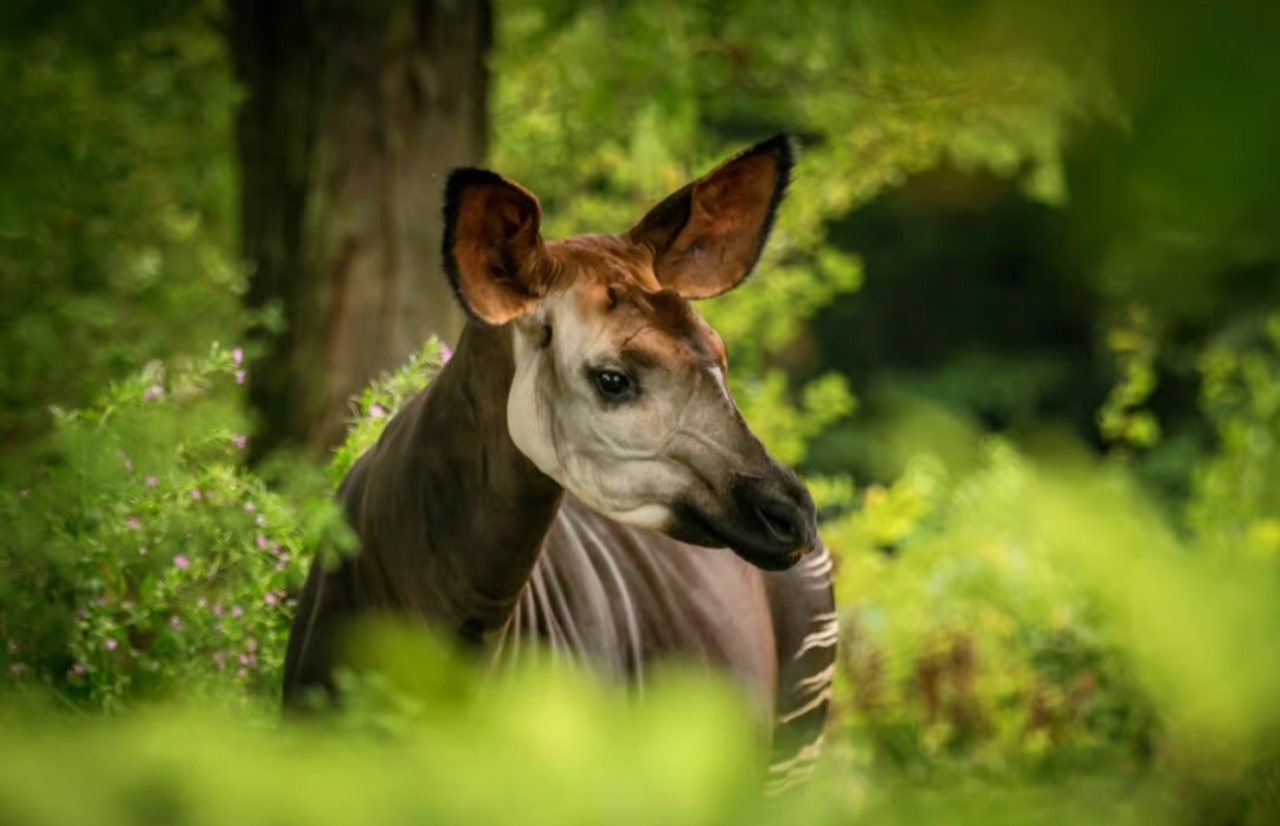
What animal has zebra stripes, a giraffe’s closest DNA, and lives hidden in the depths of the rainforest? Meet the Okapi—nature’s most mysterious masterpiece.
The Okapi stands out as one of the most unique and mysterious mammals on Earth.
The Okapi appears as if pieced together from different animals—zebra-striped legs, a giraffe-like face, and an antelope’s body. Its striking patterns provide perfect camouflage, letting it disappear into the dappled light and shadows of the rainforest.
More Giraffe Than Zebra
Often called a “zebra–giraffe hybrid”, the Okapi is a rare forest animal found only in the dense rainforests of the Democratic Republic of the Congo.
Despite its zebra-like stripes, its closest relative is actually the giraffe—confirmed through anatomy and genetic studies.
Both the Okapi and giraffe belong to the same biological family, Giraffidae, sharing key traits despite their different appearances. Like giraffes, okapis have relatively long necks—though much shorter—and a similar body structure adapted for browsing vegetation.
They also have impressively long, flexible tongues that can grow up to 30 cm. These tongues help them strip leaves from branches and even groom hard-to-reach places like their ears.
The Okapi uses its natural camouflage to stay hidden from predators like leopards. So elusive, it remained virtually unknown to the outside world until the early 1900s.
The Congo’s Hidden Unicorn
For centuries, the Okapi was known only to the indigenous peoples of the Congo Basin. Its existence remained a mystery to the outside world.
In the late 19th century, rumors of an “African unicorn” began circulating among Western scientists, sparking curiosity about this elusive forest dweller.
It wasn’t until 1901 that British explorer Sir Harry Johnston formally described the species and gave it the scientific name Okapia johnstoni.

The discovery amazed the scientific community, proving that even in an age of exploration, the natural world still held remarkable secrets.
Diet And Behavior
The Okapi is a solitary forest dweller, quietly roaming the dense rainforests in search of leaves, fruits, buds, and fungi from a variety of plants.
Their long tongues allow them to reach vegetation that many other animals cannot access
Despite their reclusive nature, okapis have a unique way of communicating. Visibility is low in their thick forest habitat, so they rely on subtle, low-frequency sounds.
These almost-whispered calls allow mothers and calves to stay in touch while remaining hidden from predators.
When a calf is born, it spends its first few months hidden in dense vegetation while the mother forages close by.
This cautious behavior helps reduce the risk of predation and highlights how well the Okapi is adapted to life in its forest environment.
Nature’s Evolutionary Mystery
The Okapi’s unique appearance is the result of millions of years of evolution in isolation.
Though it shares a common ancestor with the giraffe, it follows a very different evolutionary path.
Giraffes adapted to open grasslands with long necks to reach high foliage, while okapis stayed in dense forests, favoring shorter necks and stealthy movement.
This divergence makes the okapi a living snapshot of evolution, showing how environment shapes adaptation as much as ancestry.
Endangered In The Wild
Okapi looks strong and healthy, its population is at risk.
Despite living in remote forests, the Okapi faces serious threats.
Deforestation, mining, and human conflict in the Democratic Republic of the Congo have caused significant habitat loss.
Poaching is another major concern, as okapis are sometimes hunted for their meat and skins.
The species is classified as endangered, prompting conservation efforts such as the creation of the Okapi Wildlife Reserve, a UNESCO World Heritage Site.
Protected areas like the Okapi Wildlife Reserve are crucial for safeguarding both the okapis and their forest home.
Why The Okapi Matters
The Okapi is more than an unusual-looking animal—it embodies the rich biodiversity of the Congo rainforest.
Protecting the okapi also means protecting an entire ecosystem, home to countless other species.
This ecosystem plays a vital role in maintaining the balance of the forest and regulating the Earth’s climate.
Also Read | Runny Nose Every Day For Years? Read This
The okapi’s presence highlights the interconnectedness of species and the importance of preserving their natural habitats.
Beyond its ecological role, the okapi reminds us that the natural world still holds wonders yet to be fully understood.
Even in an age of global exploration and satellite mapping, creatures like the okapi show that mystery and discovery remain very much alive.
Nature’s Elusive Masterpiece
The Okapi is a living testament to nature’s creativity and complexity.
It defies simple classification, combining features from different animals into one harmonious form.
With zebra-like stripes and a giraffe’s lineage, the okapi is entirely unique in appearance.
Its elusive nature continues to captivate both scientists and animal lovers around the world.
In many ways, the okapi serves as a quiet ambassador for the hidden corners of our planet.
This gentle, secretive animal reminds us to look closer, ask questions, and protect the fragile beauty of life on Earth—so how many more extraordinary creatures like it are quietly surviving in the world’s unseen places?


Leave a Reply