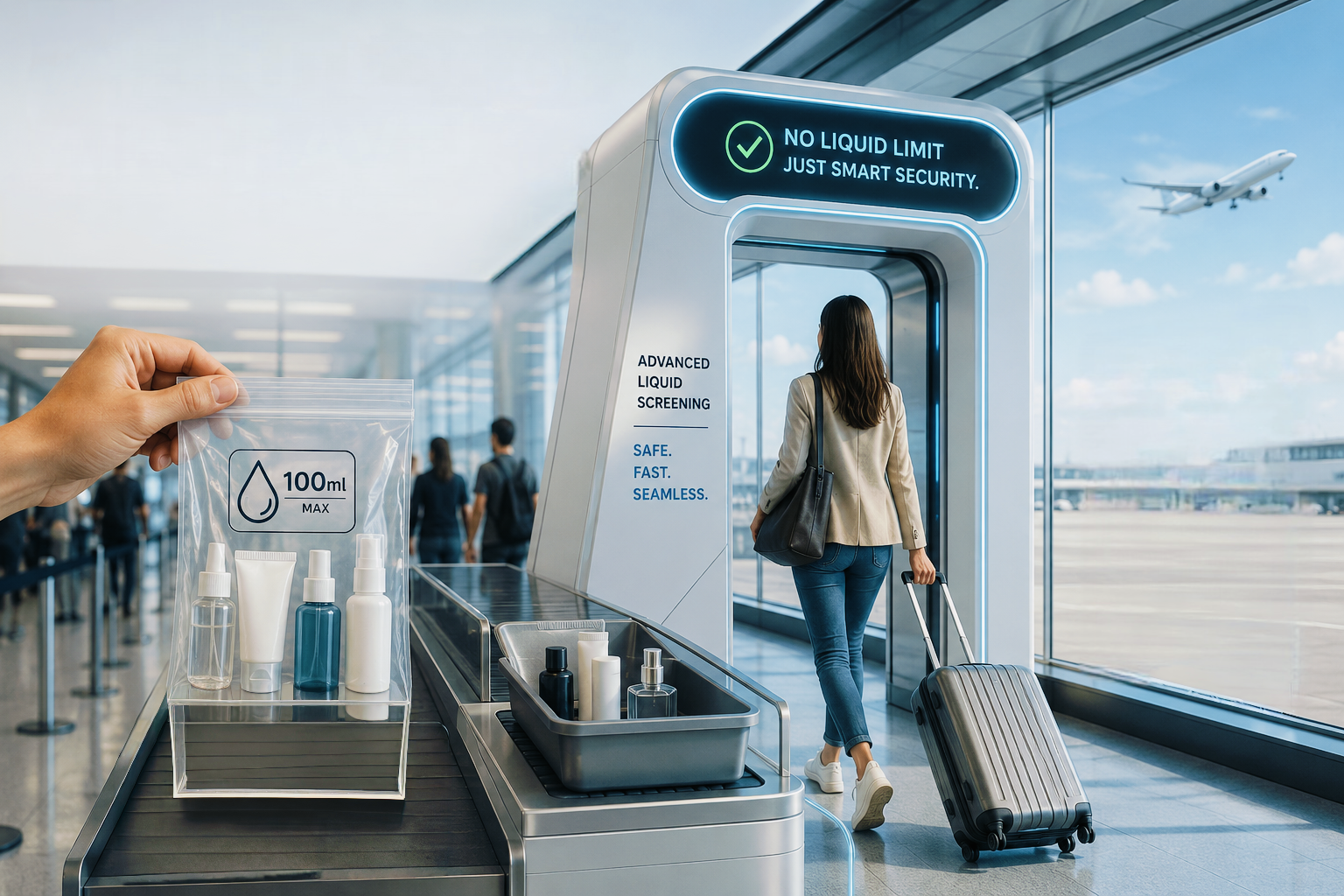
What if the biggest hassle at airport security simply vanished?
For nearly two decades, air travelers have been bound by the 100 ml liquid rule, forcing them to pack toiletries, cosmetics, gels, and drinks in small containers before passing through airport security.
Now, thanks to next-generation screening technology, that long-standing restriction may soon become a thing of the past.
Advanced scanners can detect potential threats more accurately without requiring strict liquid limits, allowing security checks to be both safer and more efficient.
As a result, several airports around the world have already relaxed or even removed the 100ml rule.
If the trend continues, travelers could soon enjoy faster checkpoints, less hassle, and a smoother airport experience, marking one of the biggest changes to air travel security in years.
Why Does The 100ml Rule Exist?
The 100ml liquid rule limits passengers to carrying liquids, gels, aerosols, creams, and pastes in containers no larger than 100ml in their hand luggage.
To pass through security, these items must also be packed inside a clear, resealable bag for easy inspection.
The restriction was introduced worldwide after the 2006 Transatlantic Aircraft Plot exposed vulnerabilities in aviation security and highlighted the challenges of screening liquid-based threats.
Nearly two decades later, the rule remains a standard part of airport security, though new screening technologies are beginning to challenge its necessity.
The Basics Of The Rule
Each liquid container in your carry-on must hold no more than 100ml.
All liquid items must fit inside a single clear, resealable plastic bag, typically with a maximum capacity of one litre.
Passengers are required to remove and present this bag separately during airport security screening.
The rule applies to everyday items such as water, soft drinks, perfumes, lotions, toothpaste, gels, and cosmetics—making it a common source of frustration and confusion for many travelers.
Smarter Security Scanners
New CT (Computed Tomography) scanners are transforming the way airport security screens luggage.
Unlike traditional X-ray machines, CT scanners create detailed 3D images of a bag’s contents.
This gives security staff a much clearer view of what’s inside without opening the bag.
The technology can identify potential threats more accurately and efficiently.
As a result, passengers may no longer need to remove liquids, laptops, or other electronic devices during security screening.
Thanks to this technology, several airports have begun allowing larger liquid containers in carry-on luggage.
Airports Leading The Change
Some airports have already begun easing the 100ml liquid restriction thanks to advanced CT scanning technology.
At Heathrow Airport, selected terminals now use next-generation scanners that allow for more flexible liquid screening.
Teesside International Airport has gone a step further, permitting passengers to carry liquids exceeding 100ml through security.
Meanwhile, selected areas of Birmingham Airport are also benefiting from CT scanners and more relaxed screening procedures.
As these upgrades expand, more airports are expected to follow suit, making travel simpler and more convenient for passengers.
Check Before You Fly
Some airports have relaxed their liquid restrictions, but travelers should still check the latest rules before heading to the airport.
Policies can vary between airports, terminals, and even individual security checkpoints.
For now, many airports across Asia, North America, and parts of Europe continue to enforce the 100ml liquid limit.
Rules Can Differ
Airport security rules aren’t always the same from one airport to another.
Requirements can vary between departure and transit airports, even within the same journey.
As a result, travelers leaving an airport with relaxed liquid restrictions may still encounter the 100ml limit at a connecting airport.
With advanced CT scanners making airport security smarter and more efficient, the long-standing liquid restriction is gradually being eased in some locations.
The 100ml rule remains in place at many airports, but the future of air travel could be faster, simpler, and far more convenient for passengers.
What would you pack if the 100ml limit disappeared tomorrow?


Leave a Reply