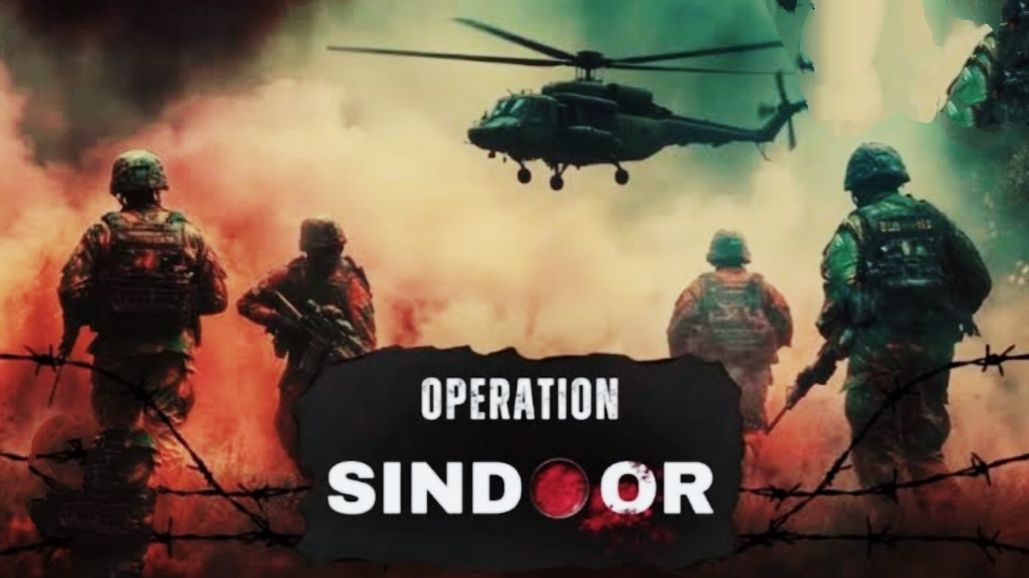
The Army, Navy, and Air Force Directors General of Military Operations (DGMOs) of India have started their joint press briefing for today. The media appearance comes after the government’s forceful statements about Pakistan’s ceasefire violations and amid increased tensions along the Line of Control.
According to DGMO Lieutenant General Rajiv Ghai,The attacks on those nine terror hubs killed over 100 terrorists, including high-value targets like Yusuf Azhar, Abdul Malik Rauf, and Mudasir Ahmed who were engaged in the IC814 hijacking and the Pulwama explosion. Soon after, Pakistan too broke the line of control, and the amount of civilians, populated villages, and religious institutions like Gurudwaras that were tragically struck by them demonstrated our enemy’s irregular and shaken response.The Indian Navy provided the precision weapons required for these operations, while the Indian Air Force played a major role by bombing several of these facilities. There were Indian Air Force assets in the air.

The military goal of Operation Sindoor was to punish the terrorists and destroy their infrastructure. The first press release from FS on May 7 already featured pictures of these strikes that evening. “We achieved total surprise,” Lieutenant General Rajiv Ghai stated during the briefing.
Our forces were still present in the Arabian Sea, fully equipped to attack specific targets, including Karachi, whenever we felt like it: Pramod
“We were ready. On the 7th, the surgeries began. They attempted, mostly in vain, to strike our military facilities on May 8 and 9, flying drones across our borders,” Ghai stated.
“Unmanned aerial vehicles and drones launched a widespread attack on our cities on the eighth and ninth. It persisted. However, Bharti continued, “we made sure that the targeted targets were unharmed.
“Once more, the enemy had demonstrated their desire to intensify the conflict and engage in combat. “We were prepared for the task,” Bharti said.
Aircraft and drones intruded on the evenings of the 9th and 10th. This time, there was a deliberate attempt to target critical logistical facilities, including airfields. According to the Pakistani army, between May 7 and May 10, between artillery and small weapons fire along the Line of Control killed about 35–40 soldiers,” Ghai continued.
Following a resurgence of cross-border hostilities, the briefing highlights the gravity of India’s security posture and is a unique instance of tri-service communication.
“The bullet will be fired from here, the bullet will be fired from there”, Prime Minister Narendra Modi’s remarks to the Indian military command represent a sea change in India’s standing along the Line of Control. Just hours after both countries declared a halt in military operations on May 10, Pakistan broke the ceasefire agreement, prompting the instruction.
India responded quickly, with the Prime Minister making it clear that India would “stop only if Pakistan stops”. This policy is currently driving India’s military operations in the wake of Operation Sindoor, an ongoing operation targeting terror hotspots in Pakistan and Pakistan-occupied Kashmir (PoK).
Following the terror assault in Pahalgam, Operation Sindoor was launched and has since grown more intense. The Indian military is said to have destroyed important terrorist infrastructure with cutting-edge weapons. Jaish-e-Mohammed’s Bahawalpur headquarters was one among the main targets, according to media sources. Additionally affected were facilities at Muridke and Muzaffarabad.
“I’ll mix it into the soil” , PM Modi reportedly said to his top brass in response to the strikes, highlighting the extent of the devastation. A senior official went on to say, “Will enter and kill”, highlighting India’s willingness to strike valuable targets located deep within Pakistani territory.
Armed Forces Press Briefing
Air Marshal AK Bharti stated, “As I said, their planes were prevented from coming inside our border,” in response to a media question regarding the Indian Air Force shooting down Pakistani aircraft. Since we don’t have any wreckage on hand, we can be certain that we have brought down a few Pakistani aircraft. I have the numbers, and we are delving into technical specifics to confirm it. Therefore, at this time, I would prefer not to include a figure.
“We have a plan and a roadmap that we will adhere to strictly,” DGMO said.
We have been forced into this circumstance, and as you can see, the Indian military is always ready to handle any emergency,” adds DGMO Lieutenant General Rajiv Ghai. Any necessary action will be taken. I’m more worried about what we’ll do than what Pakistan will think. We shall adhere to our plan and roadmap with assiduity.”
Vice Admiral AN Pramod says
Following the cowardly attacks on innocent tourists at Pahalgam in Jammu and Kashmir on April 22 by terrorists sponsored by Pakistan, the Indian Navy’s carrier battle group, surface forces, submarines, and aviation assets were promptly deployed at sea with full combat readiness, according to Vice Admiral AN Pramod. Within ninety-six hours of the terrorist attack, we conducted several weapon firings in the Arabian Sea to test and improve shipboard tactics and procedures. Our forces were still in an advanced, deterrent position in the Northern Arabian Sea, fully prepared and capable of striking specific targets on land and at sea, including Karachi, whenever we wanted.Pakistani naval and aviation troops were forced into a defensive position due to the Indian Navy’s advance deployment, primarily inside harbors or extremely near the coast, which we constantly observed. From day one, we have responded in a prudent, measured, proportionate, and non-escalating manner. To respond forcefully to any hostile action by Pakistan, the Indian Navy is still present at sea in a credible deterrent posture.
Operation Sindoor was initiated in order to punish terrorists and their strategists.
Observing what takes place this evening
India observe tonight’s events and evaluate Pakistan’s position from there. India will respond forcefully to any danger to our territorial integrity, sovereignty, or citizens.
- New Zealand Legend Kane Williamson Announces Retirement
- FIFA World Cup 2026: How Fans Can Watch Matches For Free
- YouTube Relaunches Private Chats With Age Verification
- The Future Of Air Travel: Why The 100ml Liquid Limit May Soon Disappear
- Rising Temperatures, Rising Tempers? The Surprising Link Between Heat And Aggression


Leave a Reply