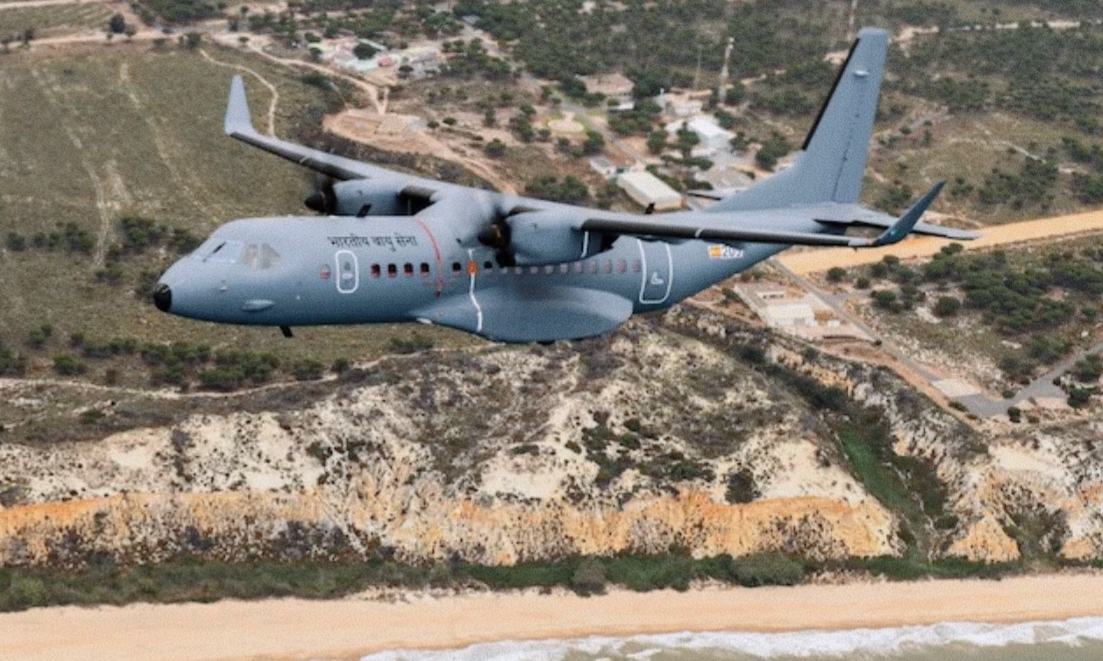
Earlier this week, External Affairs Minister S Jaishankar mentioned that the first ‘Made in India’ C295 aircraft is set to be launched before September.
It highlights how India and Spain have strengthened their defense-related industrial partnership.
This aircraft is being produced as part of a 2021 agreement between the two nations, where India confirmed the purchase of 56 Airbus C295 aircraft to replace the Indian Air Force’s (IAF) outdated AVRO 748 fleet for Rs 21,935 crore.
Last year, Airbus delivered 16 aircraft in ‘fly-away’ condition from its final assembly line in Seville, Spain, while the remaining 40 are being built and assembled by Tata Advanced Systems Limited (TASL) in India, as part of an industrial collaboration.
Features of the C295 aircraft
The C295 is a flexible transport aircraft that can perform various tasks – transporting troops and cargo, maritime patrol, airborne warning, surveillance and reconnaissance, armed close air support, medical evacuation, and airborne firefighting.
The aircraft can carry a payload of up to nine tonnes or accommodate up to 71 personnel at a maximum cruising speed of 260 knots (approximately 480 km/h).
It is also designed for air-to-air refueling of fixed-wing aircraft and helicopters.
Powered by two Pratt & Whitney turboprop engines, the aircraft can fly at altitudes of up to 30,000 feet and can take off and land quickly on unpaved, soft, and sandy or grassy airstrips.
The Airbus-Tata C295 Final Assembly Line (FAL) facility in Vadodara was inaugurated in October 2024.
It marks India’s first private sector FAL for military aircraft.
The delivery of the 40 aircraft is expected to take place between 2026 and 2031.
In 2022, TASL launched a factory in Hyderabad, kicking off the production of major airframe parts like the fuselage and tail in July 2023.
Once the key sections were put together, they were sent to Vadodara in 2024 for the installation of the engine, avionics, and other essential components. Eventually, these will be prepared for testing and delivery.
The Vadodara Final Assembly Line (FAL) is set to assemble 12 aircraft annually.
This partnership is all about creating a complete industrial ecosystem – covering everything from making complex parts to assembling, testing, delivering, and maintaining the entire aircraft lifecycle.
The contract will also provide special maintenance tools, ground support equipment, testing gear, technical manuals, pilot training programs, and a full-motion simulator, among other essentials.
Plus, a training center has been established in Agra.
Airbus will offer spare parts support for a decade and a performance-based logistics contract for five years, ensuring that 85% of the aircraft fleet is available to the force at all times.
The acquisition is significant for two main reasons.
First, it will replace the old Avro fleet from the 1960s, enhancing the IAF’s capacity to transport troops and supplies across the nation.
Additionally, the IAF also uses the C-130J Super Hercules for medium operations and the massive C-17 Globemaster III for heavier loads, both sourced from the US.
Secondly, this acquisition marks the launch of India’s first-ever ‘Make in India’ Aerospace initiative in the private sector.
Aside from key parts like the engine and avionics, which are coming from US companies Pratt & Whitney and Collins Aerospace.
Airbus is set to share manufacturing tech with TASL for most other components.
The goal is for 95% of the aircraft to be produced in India in the coming years.
The plane will feature homegrown radar warning receivers and missile approach warning systems created by Bharat Electronics Limited, and Bharat Dynamics Limited will supply the countermeasure dispensing system.
The 32nd aircraft, expected to be delivered in the first quarter of 2029, is anticipated to be almost entirely an Indian-made C295.
- Google AI Mode Unveils Search Agents That Track The Web In Real Time

- Why Tamil Nadu’s Kirti Chakra Hero Became a National Inspiration?

- Tejas Shirse Sets New 110m Hurdles National Record

- The Beauty Of Change: Eighteen Lessons From Life

- 3 Days To A Morning Person: Fact or Fantasy?

- New Zealand Legend Kane Williamson Announces Retirement

- FIFA World Cup 2026: How Fans Can Watch Matches For Free

- YouTube Relaunches Private Chats With Age Verification

- The Future Of Air Travel: Why The 100ml Liquid Limit May Soon Disappear

- Rising Temperatures, Rising Tempers? The Surprising Link Between Heat And Aggression

- India’s Lost Dragonfly Returns After 110 Years


Leave a Reply