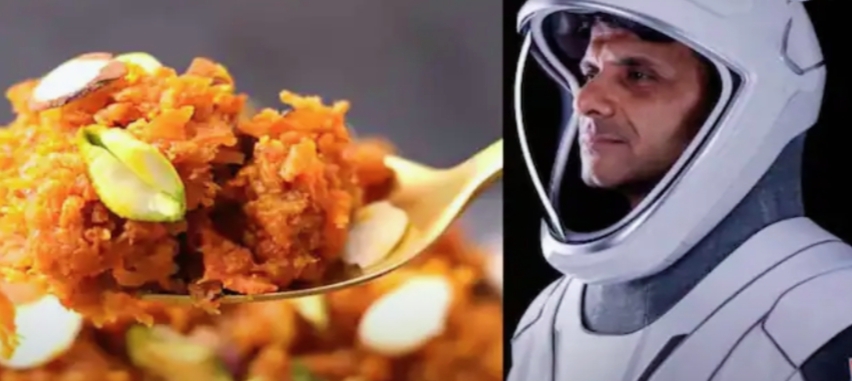
Indian astronaut Shubhanshu Shukla has spent over a week in space and has likely enjoyed several meals during that time. On Friday, Shukla mentioned that he shared the food he brought to the International Space Station (ISS) – gajar ka halwa, moong dal ka halwa, and aamras with his fellow astronauts on board.
Eating in space isn’t as easy as pie. It takes some serious planning and organization. But that doesn’t mean astronauts have to skimp on their meals or stick to just liquids. The food is definitely not boring or tasteless.
Actually, on the ISS, the ongoing space lab where Shukla is right now, astronauts frequently indulge in fancy meals. It’s just that they consume packaged food, which is stored and prepared in a unique way.
How To Eat In Space
In zero-gravity, food, like everything else up there, floats around. This means they have to be way more organized than we are on Earth.
The safety of the spacecraft might be at risk if tiny crumbs or loose bits get lodged in its essential components. These particles could also find their way into astronauts’ mouths or nostrils, which could cause choking or breathing issues. Therefore, food items are selected with care and packaged appropriately.
Eating itself, meaning the food moving through the digestive system, isn’t really a problem. Sure, gravity helps this process on Earth, but it’s not essential. In short, the only challenge in space is managing food.
Astronauts eat packaged and processed foods, which are typically dehydrated.They use a needle to inject hot water into the packages before digging in. Shukla’s gajar ka halwa and moong dal ka halwa made and packed by the Indian Space Research Organisation (ISRO) and the Defence Research and Development Organisation (DRDO) would also come in this dehydrated form.
Drinks like tea, coffee, or juices, along with Shukla’s aamras, typically come in powder form that you can mix with water before drinking. Plus, there’s a way to heat food on the ISS.
Astronauts aboard the space station typically share breakfast and dinner.Before they eat, they strap themselves in with footholds to keep from floating around. Each astronaut has a food tray equipped with utensils like spoons and forks. The cutlery and food packets are secured to the tray using velcro.They’re advised to only cut a small opening in the package and use their spoons to scoop out the food.
Seasonings like salt and pepper are on hand, but they usually come dissolved in water, which can be added to the food using droppers.
After eating, they toss waste like food packets into waste chambers, while cutlery gets wiped down. They can’t wash utensils with water.
There are plenty of food options available, and astronauts can pick their menu or favorite cuisine months before their trip. After they make their choices, nutritionists step in to offer their advice to make sure astronauts get the right nutrients while in space. For example, astronauts require more calcium and less sodium to keep their bones strong.
In the past, early space travelers mostly had to rely on food paste, which came in tubes similar to toothpaste or in small cubes. When they’re in a spacecraft, like on the way to the ISS, these types of food are still handy because of limited space and storage.
Cultivate Food In Space
Scientists are diving into concepts for growing food in space. The reason behind this is that astronauts have started to spend significantly more time up there in space.
People heading to the ISS usually stay for a few months. Because of this, not all their food is sent on the same spacecraft that takes them there. Cargo missions to the ISS happen regularly, bringing food along with other necessities like maintenance tools and scientific gear.
Different space agencies and private firms are gearing up for even longer missions in space, with the idea of establishing a permanent base on the Moon. There are also ambitions to venture much farther than we ever have in space for these missions, it might not be cost effective to bring food from Earth.
Researchers are currently investigating various factors involved in cultivating food in space and looking into different techniques to achieve this. For example, they are studying how micro gravity impacts plant growth.
They are also trying to use LED lights to promote photosynthesis. Researchers are working on soilless systems that allow plants to be cultivated in space, while also choosing the best crops for these environments.
Crops like potatoes, soybean, wheat, spinach, tomatoes, and carrots have shown potential for growing in space.
ISRO is conducting several experiments on this topic during Shukla’s time at the ISS. They plan to grow and analyze at least six different types of crop seeds.
Additionally, there’s a separate study focused on the growth of microalgae. Beyond just food, these microalgae could serve as a potential fuel source or be utilized in life support systems.
- The Future Of Air Travel: Why The 100ml Liquid Limit May Soon Disappear

- Rising Temperatures, Rising Tempers? The Surprising Link Between Heat And Aggression

- India’s Lost Dragonfly Returns After 110 Years

- Snapchat Introduces Safer Story Sharing For Under-16 Users

- Google Launches Gemini 3.5 Live Translate

- The New Dating Trend Everyone’s Talking About: Puffer-Fishing

- Tea, Coffee, Juice: The Worst Empty Stomach Mistakes

- Instagram Introduces Profile Grid Customization

- Skywatchers Alert: Jupiter And Venus Set For A Rare Close Encounter Tonight

- Chrome Just Downloaded a 4GB AI Model? Here’s How to Delete It

- Why Does Real Love Feel Different Than We Expect?

- The 30-Minute Parenting Secret Every Child Needs

- Remote Robotics: Control Robotic Arms From Your Smartphone

- Mumbai’s Pod Taxis: Will BKC Benefit?

- Beyond The Missing Period: Understanding MRKH Syndrome


Leave a Reply