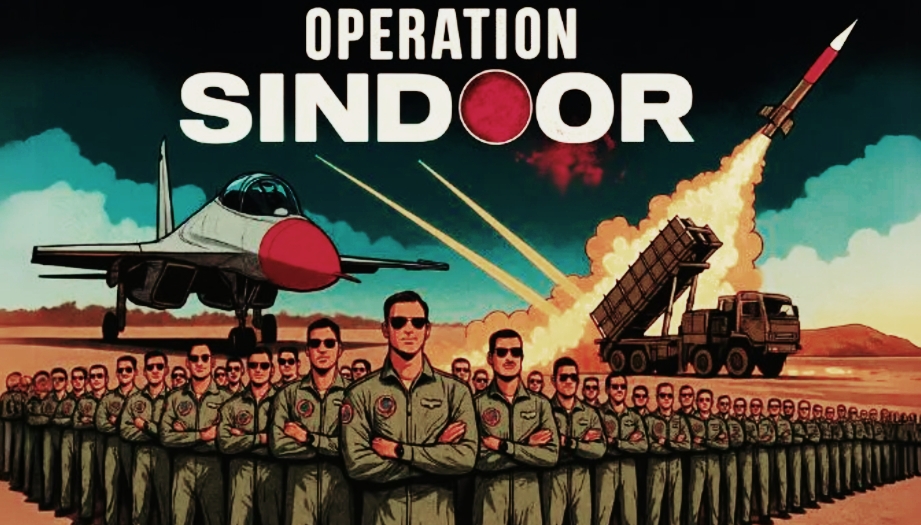
In response to the Pahalgam terrorist attack, which killed 26 innocent Hindus and was claimed by the Resistance Front (TRF), a branch of the Pakistan-based terrorist group Lashkar-e-Taiba, the Indian Armed Forces launched Operation Sindoor. As India readied itself for a war-like scenario, the Indian Armed Forces organized a military strike on terrorist camps in Pakistan and Pakistan-occupied Jammu and Kashmir in the days that followed.

India initiated the operation on May 7th and destroyed several terrorist camps. India cautioned Pakistan that the strike was directed at terror camps rather than military or civilian targets. But when more than 100 militants were killed, Pakistan chose to strike back.In response, Indian Air Defence neutralized Pakistan’s drone and missile attacks.
In response to Pakistan’s attack, India initiated the second phase of Operation Sindoor, and between 2:30 AM and 12:30 PM on May 10, the Indian Armed Forces once again targeted important military installations, forcing Islamabad to plead for peace in a matter of hours.

Operation Sindoor is significant not only because of its size and firepower but also because of its message, which shook Pakistan and its supporters alike: India will no longer tolerate terror attacks in silence.Operation Sindoor’s surgical accuracy, rapid escalation, and decisive conclusion have added a new chapter to India’s developing doctrine of retaliation and deterrence.
A Clear Instruction And A Prompt Warning
The night of May 9th was the catalyst for the events that would culminate in the operation. Interestingly, at approximately 10:30 p.m., US Vice President JD Vance contacted Prime Minister Narendra Modi. According to reports, the communication contained a serious warning that Pakistan would probably launch a huge strike in the coming hours.

PM Modi responded in a straightforward and decisive manner, saying that India was prepared to not only withstand the attack but also to strike back with greater vigor, and the Armed Forces delivered on this promise. This position had been made public following the Pahalgam attack, but Vance’s call was the final approval.
Shortly after, the three service chiefs, Gen. Upendra Dwivedi, Air Chief Marshal AP Singh, and Admiral Dinesh Tripathi, along with NSA Ajit Doval and CDS Gen. Anil Chauhan, convened India’s war council for a rapid strategy session, discontinuing the discussion of contingency plans and started implementing targeting protocols.
Pakistan Attacks First, India Reacts With Fire
At 1:30 AM, Pakistan took action. It struck Indian airbases in the north and west with the greatest vigor in recent memory. But most of the incoming fire was intercepted and neutralized by India’s sophisticated, multi-layered air defense systems, which were commanded by the powerful S-400s based at Adampur and other strategic stations. India had spent a lot of time preparing for this kind of strike, and it paid off.
Next Was India’s Retaliation
The Indian Air Force launched a volley of BrahMos, Scalp, and Crystal Maze missiles at 2:30 AM, in addition to locally produced loitering munitions such Harop and Nagastra. These assaults were destructive, persistent, and targeted.Pakistan may have been ready for such an attack, but its defenses were seriously flawed from the start.
The first wave struck the Nur Khan airbase near Rawalpindi, which is dangerously close to the Army’s GHQ in Pakistan. Since India was deep inside Pakistan, nothing could stop the Indian Armed Forces’ wrath. A C-130 plane was destroyed on the ground, two mobile command centers were destroyed, and the runway, taxiways, and apron of Rahimyar Khan airbase far to the south were pounded, and the airbase itself was rendered unusable.
The pressure on Islamabad increased as Indian Army units around the LoC and International Border pounded Pakistani positions with M-777 howitzers equipped with Excalibur ammunition.
As The Strikes Deepen, Panic Increases
India continued after that.The psychological harm increased with the second wave of Indian strikes. With terrifying accuracy, the coveted airbases of Sargodha and Murid, which house F-16 squadrons, were targeted. Islamabad were alarmed by the impact of precision strikes that penetrated so deeply into Pakistani airspace.
The panic in Pakistan began at 9:30 AM. Its High Commission in Delhi made the initial attempt at backchannel communication. India, on the other hand, declined to participate and made it apparent that Pakistan could only communicate via the military hotline if it so desired. At the same time, General Asim Munir was frantically phoning American officials to indicate that he was prepared to halt the firing.
The Last Stage- Breaking Pakistan’s Military Backbone
The third and fourth waves of strikes were launched by India while the Pakistani leadership frantically tried to restore peace. The targets of the attacks were radar stations and airbases at Rafiqui, Sukkur, Jacobabad, Bholari, Chunian, Pasrur, Arifwala, and Murid. Particularly crucial was the ongoing attack on Nur Khan, which essentially rendered Pakistan’s centralized air defense coordination inoperable.
According to reports, Gen. Munir called Prime Minister Shehbaz Sharif just before morning. Pakistan was now well aware of the extent of the harm and the pointlessness of any more provocations.
The War Is Halted By India And Pakistan
At midday, India stopped its attack. Pakistan’s DGMO made an attempt to reach his Indian colleague at 12:30 PM, but it took till 3:30 PM to connect. According to its declared ideology, India decided to stop activities at 5 PM IST. Only when Pakistan made an official request via the military hotline did this occur.

Two weeks have passed since Operation Sindoor was initiated and then put on hold. No gunfire has been heard.But Operation Sindoor has accomplished what dossiers and words could not. It proved that diplomatic declarations and defensive posture are no longer the only ways India responds to terrorism. It is timed to cause the most harm and is exact and overwhelming.
Cross-border terrorism has long been an issue for India. Operation Sindoor sent a clear and important message: India will not only protect itself but also make sure that provocations have dire repercussions. India has stated that Operation Sindoor is still ongoing and that any act of terrorism will be interpreted as a war.
- FIFA World Cup 2026: How Fans Can Watch Matches For Free
- YouTube Relaunches Private Chats With Age Verification
- The Future Of Air Travel: Why The 100ml Liquid Limit May Soon Disappear
- Rising Temperatures, Rising Tempers? The Surprising Link Between Heat And Aggression
- India’s Lost Dragonfly Returns After 110 Years
- Snapchat Introduces Safer Story Sharing For Under-16 Users
- Google Launches Gemini 3.5 Live Translate
- The New Dating Trend Everyone’s Talking About: Puffer-Fishing
- Tea, Coffee, Juice: The Worst Empty Stomach Mistakes
- Instagram Introduces Profile Grid Customization
- Skywatchers Alert: Jupiter And Venus Set For A Rare Close Encounter Tonight
- Chrome Just Downloaded a 4GB AI Model? Here’s How to Delete It
- Why Does Real Love Feel Different Than We Expect?
- The 30-Minute Parenting Secret Every Child Needs
- Remote Robotics: Control Robotic Arms From Your Smartphone
- Mumbai’s Pod Taxis: Will BKC Benefit?
- Beyond The Missing Period: Understanding MRKH Syndrome
- Why Calling Every Stomach Problem ‘Gas’ Can Be Risky?
- Poke: Apple’s First AI Agent Debuts
- AC Drying Out Your Skin? Try This Simple Fix
- Want More Fireflies? Transform Your Garden Today


Leave a Reply