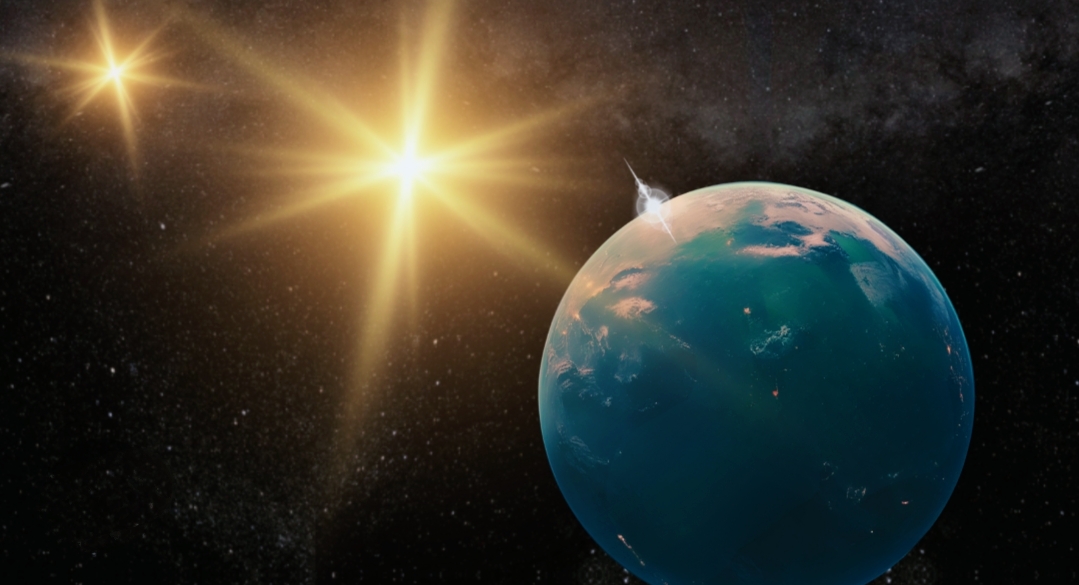
Astronomers have found a new exoplanet that appears to defy expectations in almost every way.
Starting with its remarkable resemblance to the fictional sunsets of Tatooine, the desert planet from Star Wars.
This planet, known as HD 143811 AB b, orbits a pair of stars much closer than any other directly imaged planet in a binary system, yet its year is an incredible 300 Earth years long.
Located about 446 light-years away from Earth, this system immediately attracted the attention of scientists because it is extremely rare to find a planet orbiting a twin star through direct imaging.
This discovery gives scientists a unique chance to learn how planets develop in a dual gravitational environment instead of just one.
Jason Wang, an assistant professor of physics and astronomy at Northwestern University, and his team thoroughly reviewed previous observations to identify HD 143811 AB b rather than using fresh telescope data.
They reexamined data collected over an eight-year period by the Gemini South telescope using its Gemini Planet Imager (GPI), a device specifically made to minimize starlight interference in order to detect faint planets.
At first, they didn’t expect to find much, having only identified one new planet from over 500 stars during GPI’s operational period.
After looking over data from 2016 to 2019 and checking it against follow-up observations from the W M Keck Observatory, researchers spotted a faint object’s steady movement that matched its host star, which is a major sign of a planet.
Together with an independent discovery from researchers at the University of Exeter, the team confirmed that the object’s light signature was in fact planetary, highlighting the challenges of identifying such distant worlds.
Further investigation showed that the planet is a gas giant about six times the size of Jupiter, still holding onto some heat from when it formed.
It’s around 13 million years old, in astronomical terms, it’s still considered a baby.
What makes this planet particularly fascinating is its extreme orbit. It orbits just six times closer to its binary stars than any other planet we’ve imaged in a similar system, yet the distance is still so great that it takes three centuries to finish one complete orbit.
The host stars themselves spin around each other quickly, completing a full rotation every 18 Earth days. It’s still unclear how a planet this size got into this peculiar arrangement.
DISCLAIMER: This article is derived from information available in the public domain.
- The Future Of Air Travel: Why The 100ml Liquid Limit May Soon Disappear

- Rising Temperatures, Rising Tempers? The Surprising Link Between Heat And Aggression

- India’s Lost Dragonfly Returns After 110 Years

- Snapchat Introduces Safer Story Sharing For Under-16 Users

- Google Launches Gemini 3.5 Live Translate

- The New Dating Trend Everyone’s Talking About: Puffer-Fishing

- Tea, Coffee, Juice: The Worst Empty Stomach Mistakes

- Instagram Introduces Profile Grid Customization

- Skywatchers Alert: Jupiter And Venus Set For A Rare Close Encounter Tonight

- Chrome Just Downloaded a 4GB AI Model? Here’s How to Delete It

- Why Does Real Love Feel Different Than We Expect?

- The 30-Minute Parenting Secret Every Child Needs

- Remote Robotics: Control Robotic Arms From Your Smartphone

- Mumbai’s Pod Taxis: Will BKC Benefit?

- Beyond The Missing Period: Understanding MRKH Syndrome

- Why Calling Every Stomach Problem ‘Gas’ Can Be Risky?

- Poke: Apple’s First AI Agent Debuts

- AC Drying Out Your Skin? Try This Simple Fix

- Want More Fireflies? Transform Your Garden Today

- Spotify Launches Podcast Clips For Instant Highlight Saving

- The Hidden Reason Summer Causes More Headaches

- Early Iron Deficiency Symptoms You Shouldn’t Ignore

- Meta Introduces Premium ‘Plus’ Tier For Instagram, Facebook And WhatsApp

- WhatsApp Launches Channel Status For 24-Hour Admin Updates

- 5 Powerful Signs You’re With The Right Person

- Social Media: The New Smoking For Children?

- Dewy, Glossy, Sweaty: The Viral Makeup Trend Everyone’s Trying

- Luna Launches Smart AI Band For Real-Time Daily Planning

- Meta Launches New ‘Forum’ App

- Why Is Your C-Section Scar Vertical?

- Red vs Orange Heat Alerts: Which One Puts Your Body At Greater Risk?

- Does AC Sleep Weaken Your Immunity? – Myth or Fact?

- The Rise Of Nonnamaxxing

- How To Clean Mushrooms Without Turning Them Soggy?

- How Hot Nights Quietly Harm Your Sleep And Heart?

- Indian Content Creators Can Win a Free Nepal Trip — Here’s How To Apply

- Gemini Omni Flash Brings Multimodal AI Video Creation To Google

- Essential Oil Diffusers: Healthy Trend or Hidden Hazard?

- Gmail Users Alert: Your Free 15 GB Storage Could Disappear

- YouTube Introduces Likeness Detection For 18+ Users

- AI vs Human Language: Is Learning Still Worth It?

- OpenAI Unveils ChatGPT Finance Tools With Direct Bank Integration

- The Ageing Risk Of Sleeping Too Much Or Too Little

- Fitness or Future Pain? The Truth About Joint-Damaging Workouts

- Salt Water Trend: What You Need To Know First?

- X Launches History Tab For Likes, Bookmarks And Videos

- Stay Chill: Smart Gadgets For Summer

- Instagram Launches Instant For Disappearing Photos

- ChatGPT App Now Supports Codex Coding Tool

- Best Smart Devices For Senior Citizens

- Why Did Humans Use To Eat Soil, And Why Do Some Still Do?


Leave a Reply