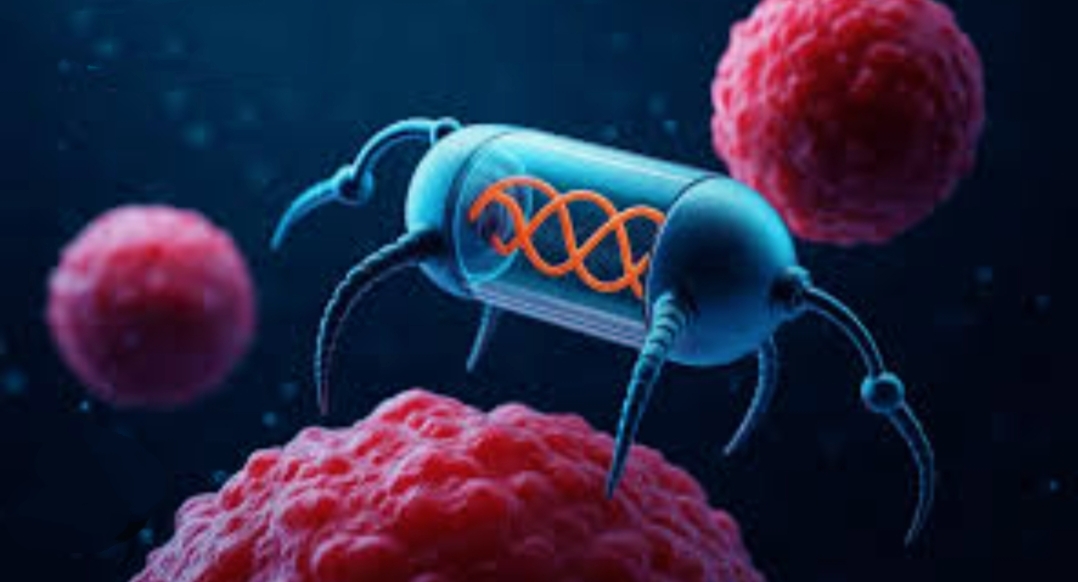
Current cancer treatments face the hurdle of getting medications deep into tumors while protecting healthy tissue, a challenge that needs to be tackled to unlock the potential of targeted and personalized medicine.
Magnetic nanorobots that can navigate through blood, dense tissues, and even individual cells.
This innovative approach could revolutionize cancer treatment by offering targeted, minimally invasive therapies that minimize side effects, speed up recovery, and reduce costs.
How these nanorobots operate, along with the imaging technologies that will enable doctors to visualize and direct the nanorobots in real-time during diagnosis and treatment.
Nanorobot, which has a tiny helix-shaped tail, mimics the motion of bacteria. It acts like a boat’s propeller or a corkscrew as it moves through various environments. As the helix spins, the device advances like a coiled spring.
In this design, the helix is fitted with a small magnet that generates magnetic fields to replicate a drilling action.
These nanobots serve as nanoswimmers, effectively acting as delivery vehicles to transport drugs to the targeted tissue. The drug is either coated on the surface or at the tip.
The main body is constructed from silica, which is biocompatible, while the magnetic component is iron, which caps the helical nanostructure, all materials already utilized in medical nanobots.
The magnetic field guides the nanobot directly to the targeted issue, allowing it to respond optimally based on its unique characteristics tailored to the issue.
The nanobot can selectively attach to cancer cells after navigating their surroundings without harming non-cancerous tissues.
The nanobot has shown success against cancer cells and specific bacteria, meaning it can essentially act as a drug itself.
By adding specific components to the helix, the nanobot may also serve as a beacon that illuminates during an MRI, helping the oncosurgeon find the tumor and administer targeted treatments.
This makes these nanobots quite versatile.
It has proven especially effective against ovarian and breast cancer cells, and also it will be useful against other forms of cancer.
The nanobots have already shown effectiveness against bacteria, and it exploring some straightforward applications in dentistry, like root canal treatments.
A root canal infection occurs when the stubborn and antimicrobial-resistant E.faecalis bacteria invade the inner pulp of the tooth, leading to inflammation or decay.
In this scenario, nanobots have proven to be a pain-free alternative to the traditional sodium hypochlorite, which is the standard irrigant used in root canal procedures.
Sodium hypochlorite is employed to disinfect canals, eliminate bacteria, and dissolve infected pulp or necrotic tissue. However, it is not always 100 percent effective in eradicating bacteria and can cause significant damage to surrounding soft tissues if it exceeds the tooth apex, resulting in severe pain and swelling.
It has been noted that nanobots may even be able to restore and remineralize teeth. Due to their 100% efficacy in animal studies, it is currently undergoing clinical trials.
It must carry out clinical trials and animal research to guarantee scientific accuracy.
The tricky part will be managing costs since they vary based on scale and demand.
The real hurdle is creating a market-friendly version and gaining acceptance from both doctors and patients.
DISCLAIMER: This article is derived from information available in the public domain.It’s always a good idea to check your doctor before beginning any new routine.
- The Future Of Air Travel: Why The 100ml Liquid Limit May Soon Disappear

- Rising Temperatures, Rising Tempers? The Surprising Link Between Heat And Aggression

- India’s Lost Dragonfly Returns After 110 Years

- Snapchat Introduces Safer Story Sharing For Under-16 Users

- Google Launches Gemini 3.5 Live Translate

- The New Dating Trend Everyone’s Talking About: Puffer-Fishing

- Tea, Coffee, Juice: The Worst Empty Stomach Mistakes

- Instagram Introduces Profile Grid Customization

- Skywatchers Alert: Jupiter And Venus Set For A Rare Close Encounter Tonight

- Chrome Just Downloaded a 4GB AI Model? Here’s How to Delete It

- Why Does Real Love Feel Different Than We Expect?

- The 30-Minute Parenting Secret Every Child Needs

- Remote Robotics: Control Robotic Arms From Your Smartphone

- Mumbai’s Pod Taxis: Will BKC Benefit?

- Beyond The Missing Period: Understanding MRKH Syndrome

- Why Calling Every Stomach Problem ‘Gas’ Can Be Risky?

- Poke: Apple’s First AI Agent Debuts

- AC Drying Out Your Skin? Try This Simple Fix

- Want More Fireflies? Transform Your Garden Today

- Spotify Launches Podcast Clips For Instant Highlight Saving

- The Hidden Reason Summer Causes More Headaches

- Early Iron Deficiency Symptoms You Shouldn’t Ignore

- Meta Introduces Premium ‘Plus’ Tier For Instagram, Facebook And WhatsApp

- WhatsApp Launches Channel Status For 24-Hour Admin Updates

- 5 Powerful Signs You’re With The Right Person

- Social Media: The New Smoking For Children?

- Dewy, Glossy, Sweaty: The Viral Makeup Trend Everyone’s Trying

- Luna Launches Smart AI Band For Real-Time Daily Planning

- Meta Launches New ‘Forum’ App

- Why Is Your C-Section Scar Vertical?

- Red vs Orange Heat Alerts: Which One Puts Your Body At Greater Risk?

- Does AC Sleep Weaken Your Immunity? – Myth or Fact?

- The Rise Of Nonnamaxxing

- How To Clean Mushrooms Without Turning Them Soggy?

- How Hot Nights Quietly Harm Your Sleep And Heart?

- Indian Content Creators Can Win a Free Nepal Trip — Here’s How To Apply

- Gemini Omni Flash Brings Multimodal AI Video Creation To Google

- Essential Oil Diffusers: Healthy Trend or Hidden Hazard?

- Gmail Users Alert: Your Free 15 GB Storage Could Disappear

- YouTube Introduces Likeness Detection For 18+ Users

- AI vs Human Language: Is Learning Still Worth It?

- OpenAI Unveils ChatGPT Finance Tools With Direct Bank Integration

- The Ageing Risk Of Sleeping Too Much Or Too Little

- Fitness or Future Pain? The Truth About Joint-Damaging Workouts

- Salt Water Trend: What You Need To Know First?

- X Launches History Tab For Likes, Bookmarks And Videos

- Stay Chill: Smart Gadgets For Summer

- Instagram Launches Instant For Disappearing Photos

- ChatGPT App Now Supports Codex Coding Tool

- Best Smart Devices For Senior Citizens

- Why Did Humans Use To Eat Soil, And Why Do Some Still Do?


Leave a Reply