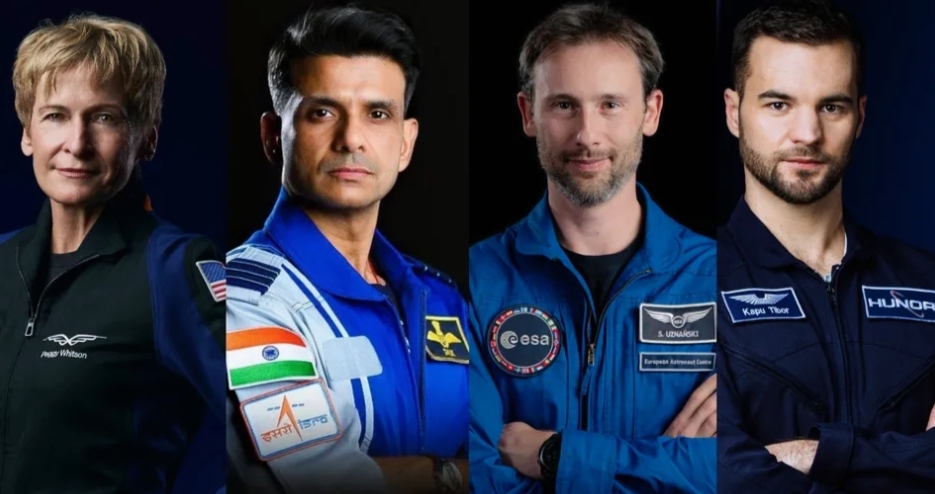
After several postponements, the Axiom-4 (Ax-4) mission finally took off at 2:31 AM Eastern Time (12:01 PM IST) on Wednesday. India’s Group Captain Shubhanshu Shukla, along with three crew members veteran astronaut Peggy Whitson (US) serving as commander, Polish engineer Sławosz Uznański, and Hungarian researcher Tibor Kapu launched into space.
Shukla, the pilot for Ax-4, is just the second Indian to make it to space and the first to take on an important operational role during a mission on the International Space Station (ISS).
As the mission approached, Shukla mentioned, “Even stars are within reach”. He emphasized that he wouldn’t just be bringing instruments and gear, but also the “hopes and dreams of a billion hearts”.
The mission took off on a SpaceX
Falcon-9 rocket from Launch Complex 39A at Nasa’s Kennedy Space Center in Florida.
The team is set to head to the orbiting
lab aboard a new SpaceX Dragon space craft. They aim to dock at about 7am Eastern Time (which is around 4.30pm IST) on Thursday, June 26.
This launch chance follows discussions between Nasa and Roscosmos (the Russian space agency) about the recent repair progress in the transfer tunnel located at the back end of the Zvezda service module of the orbital lab.
Nasa and Roscosmos decided to reduce the pressure in the transfer tunnel to 100mm of mercury. The teams will keep evaluating the situation as they move ahead. Nasa emphasized that safety is still the main concern for both the agency and Roscosmos.
“Nasa and Roscosmos have been working together for a long time on the ISS. This professional partnership has enabled both agencies to develop a common technical strategy, and now the Ax-4 launch and docking will move forward”, stated acting Nasa administrator Janet Petro.
For this mission, NASA handles integrated operations, starting when the spacecraft approaches the space station, continuing throughout the crew’s time on the orbiting lab where they conduct science, education, and commercial activities, and wrapping up once the spacecraft leaves the station.
Currently, the launch and separation of the Dragon capsule have gone well, but the trip to the ISS isn’t a direct route. In the next 24 to 28 hours, Dragon will perform a number of engine burns with its onboard thrusters. These will elevate and modify its orbit, helping it to align with the path of the space station.
These maneuvers are scheduled to the
second. Even a tiny delay might impact the
rendezvous window. Dragon relies on GPS data,radiolocation, and its own sensors to constantly monitor both its location and that of the ISS.
As soon as Dragon gets within range, it starts a slow and steady approach. It stops at a few pre-determined spots – known as waypoints – beginning from 400 meters away and gradually getting closer. At every point, ground controllers and onboard systems evaluate if they should continue.
When Dragon is about 20 meters away, it will start its final approach. It uses a set of laser sensors and cameras to perfectly align with the docking port on the Harmony module of the station.
The spacecraft subsequently advances at a mere few centimetres per second until it establishes contact.
The initial stage is a soft capture, where magnets softly draw the capsule into place. This is succeeded by a hard capture mechanical latches and hooks lock the spacecraft in, creating a pressure-tight seal between Dragon and the ISS. After docking is finished, the crew isn’t permitted to leave their vehicle and enter the station right away.
Engineers on the ground conduct a series of leak checks and confirm that the pressure inside the docking vestibule is stable. Once verified, the hatches between Dragon and the ISS will open.
For Shukla, the mission pilot, this isn’t just a personal milestone. It’s a proud moment for India’s growing involvement in global space exploration. While India launched its first astronaut into space, Wing Commander Rakesh Sharma, four decades back, Shukla’s mission signifies a huge advancement. He’s not just going to space; he’s taking on the role of pilot for one of the most research-heavy commercial missions to the ISS that has ever been attempted.
The team of four will conduct over 60 science experiments, with seven coming from India. These experiments will focus on metabolic diseases, the impact of microgravity on muscle and plant growth, microbial behavior, cognitive function, and materials testing. Researchers from over 30 different countries have played a part in contributing to the mission’s payload.
The team features seasoned astronaut Peggy Whitson (US) as the commander, along with Polish engineer Sławosz Uznański, Hungarian researcher Tibor Kapu, and Shukla, an IAF test pilot. Their involvement is part of a larger Indian goal to acquire spaceflight experience in preparation for the Gaganyaan programme, which will be the nation’s inaugural crewed space mission.
SpaceX’s Dragon capsule, known as C213,
once it reaches orbit, will take about 28 hours to get to the ISS. After finishing their
science program, the crew will undock and
splash down near the California coast.
Shukla’s duties include keeping an eye on essential flight systems, performing
manual docking procedures if necessary, and ensuring crew safety during both launch and return.

Shukla has been preparing for months, training with Axiom, NASA, ESA, and SpaceX for this mission, along with Russia’s Gagarin Centre as part of Gaganyaan, all while accumulating over 2,000 flying hours as a test pilot.
- YouTube Relaunches Private Chats With Age Verification

- The Future Of Air Travel: Why The 100ml Liquid Limit May Soon Disappear

- Rising Temperatures, Rising Tempers? The Surprising Link Between Heat And Aggression

- India’s Lost Dragonfly Returns After 110 Years

- Snapchat Introduces Safer Story Sharing For Under-16 Users

- Google Launches Gemini 3.5 Live Translate

- The New Dating Trend Everyone’s Talking About: Puffer-Fishing

- Tea, Coffee, Juice: The Worst Empty Stomach Mistakes

- Instagram Introduces Profile Grid Customization

- Skywatchers Alert: Jupiter And Venus Set For A Rare Close Encounter Tonight

- Chrome Just Downloaded a 4GB AI Model? Here’s How to Delete It

- Why Does Real Love Feel Different Than We Expect?

- The 30-Minute Parenting Secret Every Child Needs

- Remote Robotics: Control Robotic Arms From Your Smartphone

- Mumbai’s Pod Taxis: Will BKC Benefit?

- Beyond The Missing Period: Understanding MRKH Syndrome

- Why Calling Every Stomach Problem ‘Gas’ Can Be Risky?

- Poke: Apple’s First AI Agent Debuts

- AC Drying Out Your Skin? Try This Simple Fix

- Want More Fireflies? Transform Your Garden Today

- Spotify Launches Podcast Clips For Instant Highlight Saving

- The Hidden Reason Summer Causes More Headaches

- Early Iron Deficiency Symptoms You Shouldn’t Ignore

- Meta Introduces Premium ‘Plus’ Tier For Instagram, Facebook And WhatsApp

- WhatsApp Launches Channel Status For 24-Hour Admin Updates

- 5 Powerful Signs You’re With The Right Person

- Social Media: The New Smoking For Children?

- Dewy, Glossy, Sweaty: The Viral Makeup Trend Everyone’s Trying

- Luna Launches Smart AI Band For Real-Time Daily Planning

- Meta Launches New ‘Forum’ App

- Why Is Your C-Section Scar Vertical?

- Red vs Orange Heat Alerts: Which One Puts Your Body At Greater Risk?

- Does AC Sleep Weaken Your Immunity? – Myth or Fact?

- The Rise Of Nonnamaxxing

- How To Clean Mushrooms Without Turning Them Soggy?

- How Hot Nights Quietly Harm Your Sleep And Heart?

- Indian Content Creators Can Win a Free Nepal Trip — Here’s How To Apply

- Gemini Omni Flash Brings Multimodal AI Video Creation To Google

- Essential Oil Diffusers: Healthy Trend or Hidden Hazard?

- Gmail Users Alert: Your Free 15 GB Storage Could Disappear

- YouTube Introduces Likeness Detection For 18+ Users

- AI vs Human Language: Is Learning Still Worth It?

- OpenAI Unveils ChatGPT Finance Tools With Direct Bank Integration

- The Ageing Risk Of Sleeping Too Much Or Too Little

- Fitness or Future Pain? The Truth About Joint-Damaging Workouts

- Salt Water Trend: What You Need To Know First?

- X Launches History Tab For Likes, Bookmarks And Videos

- Stay Chill: Smart Gadgets For Summer

- Instagram Launches Instant For Disappearing Photos

- ChatGPT App Now Supports Codex Coding Tool

- Best Smart Devices For Senior Citizens

- Why Did Humans Use To Eat Soil, And Why Do Some Still Do?

- How Your Body Responds To Sleep Deprivation

- Glow Naturally: Simple Habits For Healthier Skin

- Google Chrome Too Messy? Easy Tricks For Smoother Browsing

- Faustino Oro Becomes Chess’s Second-Youngest Grandmaster

- The World’s First Railway: Where It Began?

- Google Upgrades Cars With Gemini AI

- The Hidden Warning On Your Skin: Early Signs Of Diabetic Rash

- Amazon Launches Vertical Feed For Prime Video

- Say Goodbye To Mosquitoes Naturally With These 6 Plants

- Puffy Face? Simple Ways To De-Puff Your Face

- Google Launches Fitbit Air: A New Era In Sleep And Recovery Tracking Begins

- Planning A Trip To Rudranath Temple? Here’s The Complete Reopening Guide

- Japan’s Simple Secrets To Heart Health

- Ube Coffee: Trendy Treat or Overhyped Drink?

- Don’t Ignore These AC Warning Signs

- Thinking About Them Nonstop? The Rise Of Limerence

- The Rise Of The ‘Ick’ In Modern Dating

- Step By Step: The Simple Habit That Lowers Blood Pressure Fast

- Galaxy AI Glasses Official, Samsung Teases Earbuds Upgrade

- What Rice Water Really Does To Your Skin Overnight?

- Robots At The Gate: Tokyo’s Bold Airport Experiment

- 5AM Routine: Start Your Day With Gentle Habits

- From Idea To File: Gemini Generates Docs And Spreadsheets

- Your Dog Knows Best? Why They Avoid Certain People

- Free Comics Online: 4 Easy Ways To Start Reading Today

- YouTube Tests AI Search With Smart Answers And Video Results

- Why Some Animals Eyes Glow In The Dark?

- Why Late Nights Win And Early Mornings Fail?

- Navigate Like a Pro: 8 Hidden Google Maps Features

- Watermelon And Digestion: Friend Or Foe After Eating

- Left or Right? How Your Sleep Side Affects Your Heart


Leave a Reply