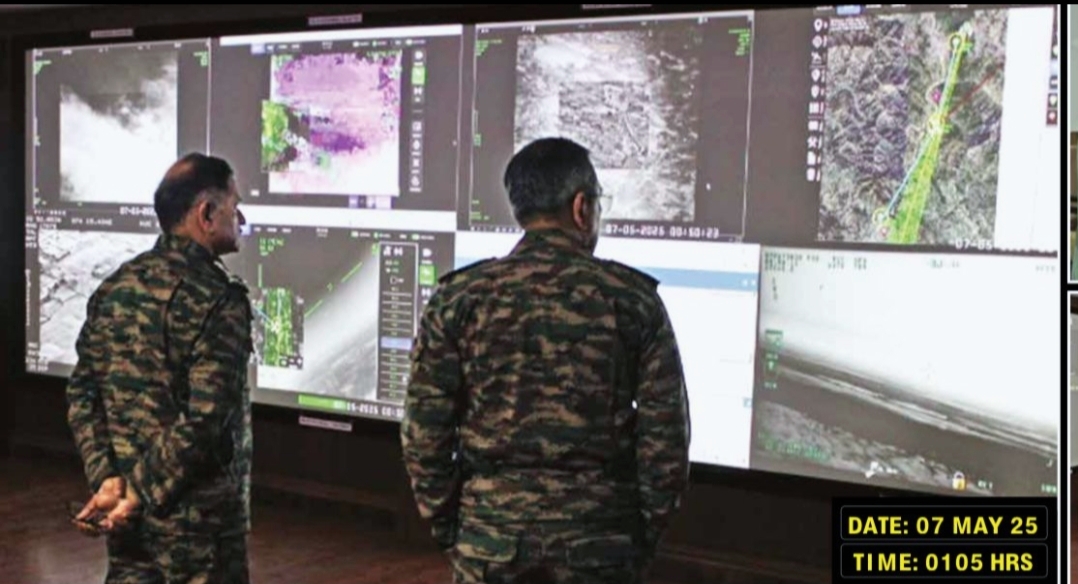
On Monday, The Indian Army published a picture of the operations room during the night of May 7, when Operation Sindoor was underway against terrorist camps in Pakistan and Pakistan-occupied Jammu and Kashmir (PoJK).
Top military officials, including Air Force Chief Marshal AP Singh, Navy Chief Admiral Dinesh K. Tripathi, and Army Chief Gen. Upendra Dwivedi, were seen in the picture keeping an eye on the operation.

The Indian Army conducted ‘Operation Sindoor’ on nine terrorist hideouts in Pakistan and PoJK that were owned by the outlawed groups Jaish-e-Mohammed, Lashkar-e-Taiba, and Hizbul Mujahideen.
Five targets were located in Pakistan-occupied Kashmir, while four sites were struck on Pakistani soil as part of the strategic operation. Two weeks after the 26-person Pahalgam terror assault, the military strikes were executed.
The Army, Navy, and Air Force worked together to carry out “Operation Sindoor” from Indian territory; the defense ministry called the operation “focused, measured, and non-escalatory” and said it purposefully avoided Pakistani military sites.
On Saturday, Prime Minister Narendra Modi reaffirmed that the states need to institutionalize civil defense readiness and that Operation Sindoor should not be viewed as a one-time affair.
At the Niti Ayog Governing Council meeting, Prime Minister Modi stated that the states needed to update their civic preparedness strategies. We need institutionalize civil defense preparedness, he stated, adding that the recent simulated drills have brought civil defense back into the spotlight.
On Monday, S Jaishankar, the minister of external affairs, presided over a meeting of the Consultative Committee of Parliament on External Affairs to talk about the military strikes conducted as part of Operation Sindoor and cross-border terrorism.
In addition to addressing opposition concerns, the discussion clarified the operation’s political, military, and global facets.
ANI sources claim that the panel was informed that the government purposefully selected high-value terror targets ahead of time in order to send a clear message and highlight Pakistani military’ incapacity to defend terrorist hotspots. Officials stated that the strikes had a significant psychological effect on the Pakistani military. India’s diplomatic approach was also emphasized by the EAM.

The Modi administration sent seven multi-party delegations to various capitals after Operation Sindoor to communicate India’s zero-tolerance stance against terrorism. With the exception of Turkey, China, and Azerbaijan, the majority of nations applauded India’s decision.
- Zoho Releases Free Agentic AI Tools For Business
- Yuki Bhambri Advance To Men’s Doubles Semifinals
- YouTube Tests AI Search With Smart Answers And Video Results
- YouTube Offers Millions Of Creators Multilingual Audio
- YouTube Offers A More Immersive And Clean Video Player
- YouTube Monetization New Policy Updated
- YouTube Introduces Likeness Detection For 18+ Users
- YouTube Introduces AI Search Results For Premium Members
- YouTube Detect Users Under The Age Of 18
- YouTube Announces New Training Programs, Collaborations, And AI Tools For Creators In India
- Your Pressure Cooker Should Be Replaced At This Time
- Your Dog Knows Best? Why They Avoid Certain People
- Your Dog Can Read Your Thoughts
- Your Daily Bike Ride Is Aging Your Skin – Here’s How?
- Your Body React If You Stopped Consuming All Carbohydrates
- Young, Exhausted, Forgetful: The Real Reason Your 20s Feel Like A Blur
- Young Lieutenant Shashank Tiwari Lost His Life In Sikkim While Rescuing A Fellow Soldier


Leave a Reply