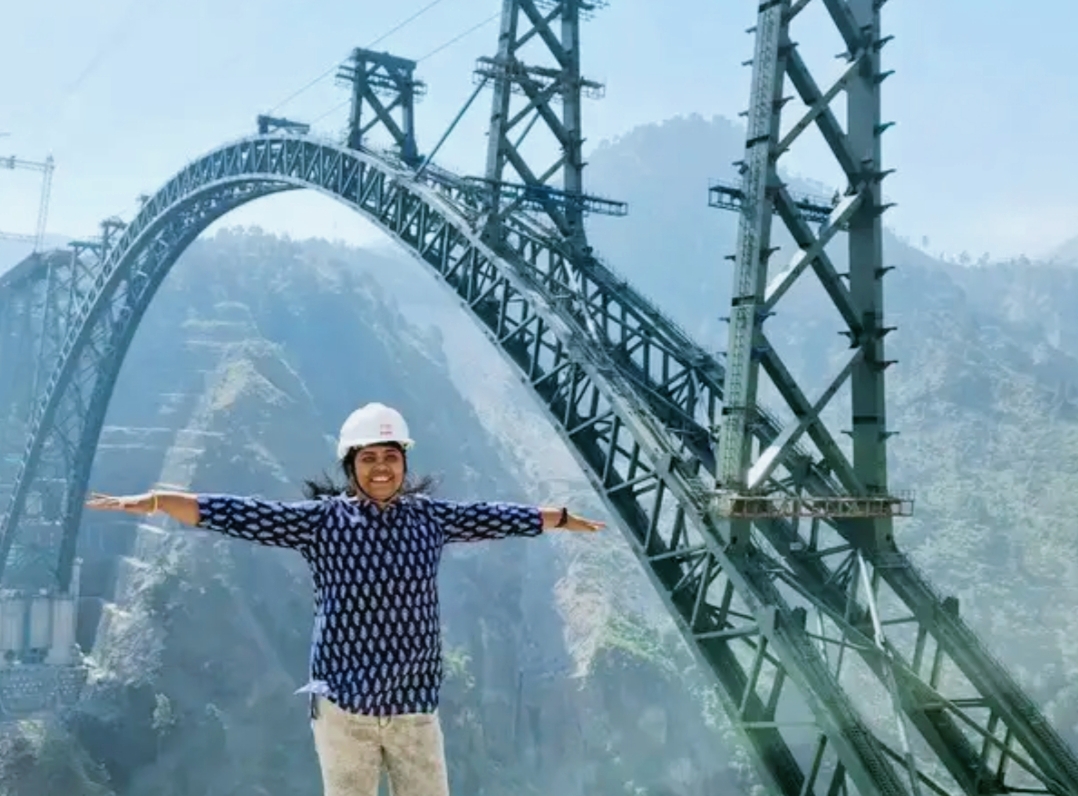
The engineering achievement was the main focus of PM Narendra Modi’s Friday opening of the tallest railway bridge in the world across the Chenab River in Jammu and Kashmir. A quiet yet crucial academic from Bengaluru worked behind the scenes to create this wonder.
Professor Dr. G Madhavi Latha of the Indian Institute of Science (IISc) has been a geotechnical consultant for the Chenab Bridge project for the past 17 years. The project is a component of the ambitious 272 km Udhampur-Srinagar- Baramulla Railway Link (USBRL).
The government referred to the bridge, which is 35 meters taller than the Eiffel Tower and cost Rs 1,486 crore, as the “biggest civil engineering difficulty faced by any Indian railway project in recent history”.
Madhavi Latha
Latha collaborated closely with the project’s principal contractor, Afcons, to address the region’s intricate topography and geology.
She was responsible for providing guidance on the positioning of rock anchors to stabilize slopes and guaranteeing structural integrity during construction. She later documented the procedures and difficulties she faced in an article she wrote for the Indian Geotechnical Journal.
Latha started her academic career with a B.Tech in Civil Engineering from JNTU in 1992 and then went on to receive a gold medal for her M.Tech in Geotechnical Engineering from NIT Warangal. She is currently a HAG professor at IISc.
In 2000, she earned her PhD from IIT Madras. In 2022, she was listed among India’s “Top 75 Women in STEAM” and in 2021, the Indian Geotechnical Society recognized her the Best Woman Geotechnical Researcher. Her most significant and long-lasting contribution is the Chenab Bridge, a project that was initially authorized in 2003.

The magnificent construction of the tallest railway bridge in the world in Kashmir Prior to steel arches crossing the Chenab River or construction cranes dotting the skyline, the world’s tallest railway bridge was built using something far more humble: mules and horses.
During the initial phases of the project, when there were no access roads, engineers and laborers had to use animals to get across the difficult Himalayan terrain. A representative from Afcons Infrastructure, the company responsible for the engineering achievement, told PTI that “at first, the project team used mules and horses to reach the location”.
To provide room for equipment and supplies, temporary tracks were installed over time and progressively replaced by permanent access roads, which are 12 km on the south bank and 11 km on the north.
A decades-long engineering dream to connect Kashmir to the rest of the nation by train was finally realized. The Chenab Bridge is currently 35 meters higher than the Eiffel Tower, rising 359 meters above the riverbank.
Each and Every workers who worked on this project has contributed significantly to the creation of this miracle. Bravo to every workers.Thanks to all the animals used in this project.
- Canine Distemper Virus Treatment In Dogs
- Corona Virus(COVID-19)
- INDIAN SONG AGAIN CREATES HISTORY IN OSCAR 2023 – BEST ORIGINAL SONG NATTU NATTU
- OSCAR 2023 : THE FIRST INDIAN FILM WINS BEST DOCUMENTARY SHORT FILM
- Ravindra Jadeja Says Anything for Mahi Bhai!!!CSK Fans sings Mannipayya!!CSK wins Fifth IPL Title!
- Ravindra Jadeja Says Anything for Mahi Bhai!!!CSK Fans sings Mannipayya!!CSK wins Fifth IPL Title!
- Chandrayaan 3 India Mission – Tik Tik Crucial 15 minutes!!!
- In the India-Pakistan War, Andhra Soldier Murali Nayak Lost His Life.
- About Monkeypox | Symptoms| Transmission | Treatment
- The PM of Buzdil is unable to articulate Modi’s name: In a scathing speech, A Pakistani MP attacks Shehbaz Sharif and reveals the army-backed coalition
- Lance Naik Dinesh Kumar arrive in Haryana village during Pakistan bombardment in Poonch; the martyr’s father declares, “Two more sons are still serving the nation.”
- Which Female Officers oversaw the “Operation Sindoor” media briefing?
- PAKISTAN DIALED INDIA – Go Back To Fighting or Peace
- WHAT ON EARTH JUST TOOK PLACE
- What Does India and Pakistan’s Ceasefire Agreement Mean
- Operation Sindoor: A Joint Army, Air Force, and Navy Report on the India-Pakistan War
- Operation Sindoor Cost Us Five Soldiers: Indian Military Honors
- Transcript of the MOD’s April 10, 2025, special briefing on Operation Sindoor
- Virat Kohli Leaves The Test Cricket League
- Rohit Sharma Declares His Retirement From Playing Test Cricket.
- Today’s Speech by PM Narendra Modi
- Operation Sindoor’s Weapon – BrahMos
- The Heroes Of Operation Sindoor: The Integrated Air Command And Control System
- How The World Media Responded To Virat Kohli’s Retirement
- India’s Reaction To Pakistan’s Retaliatory Attacks – Before and After Photos Of Targets In Pakistan
- Every day, A Keralan Teacher Would Swim Across A River To Teach Rural Kids
- Indian Users Of Amazon Prime Video Will Pay More For Ad-Free Programming
- War Anxiety: What is it and How to handle it
- Pakistani Prime Minister Shehbaz Proposes “Peace” Talks With India
- Apple’s Decision To Shift iPhone Production To India Has Angered Trump
- The Army Explains How 6 Terrorists Were Killed In Jammu & Kashmir
- List Of Nations Waiting In Line To Purchase BrahMos After Operation Sindoor
- The 22-Hour Countdown For The PSLV C-61 Rocket Begins Today
- The 90-meter Mark And Neeraj Chopra – Doha Dream Come True
- The Indian Army Releases A New Operation Sindoor Video
- Minutes After The 101st Large Rocket Launch By ISRO Takes Off, The Satellite Is Lost
- The Indian Army Releases New Footage Of Operation Sindoor
- They Fired The Bullet, But We Had An Effect
- Joe Biden’s 2022 Video Goes Viral After Being Diagnosed With Prostate Cancer
- Increased COVID Cases In Singapore And India
- India’s Operation Sindoor: Redefining Retaliation From Balakot To Bahawalpur
- Mission: Impossible – The Final Reckoning
- Google Introduced AI- Powered Features For Google Meet Users
- Google Introduces An AI Coding Assistance And A Tool For UI Designs
- A Retired Maths Teacher Abandoned By Her Children And Forced To Beg -Until Her Former Student Rescued Her
- Important Warning To Concertgoers
- In J&K’s Kishtwar, A Soldier Lost His Life During A Clash With Terrorists
- India’s Launches First AI-Based Blood Test – No Needle! No Pain
- Learning The New Language Is No Longer Necessary
- Muslim Couple Shares Wedding Hall With Hindu Couple – Surprising Reason
- Young Lieutenant Shashank Tiwari Lost His Life In Sikkim While Rescuing A Fellow Soldier
- Why Do The Two Sides Of The Moon Appear Different
- The Indian Army Says,”No More Begging; War Is Coming”
- After Shocking Barcelona, Arsenal Wins The Women’s Champions League
- A Racing Driver Who Challenges Actor Ajith Kumar
- Seven Countries, You Can Visit Them In A Single Day
- Top Scores In IPL History: SRH Surpasses 250 Once More
- Chennai Super Kings Celebrate Their Final Game In Style
- How Pakistan Ended Up Asking For A Ceasefire Following A 10-hour Airstrike By India On Its Military Bases
- Who Is The World Champion Gukesh’s Opponent In The Opening Round Of The Norway Chess Tournament
- Annabelle Doll Missing: Haunted Disappearance And Local Panic


Leave a Reply